




Understanding the Goals of Jaw Surgery
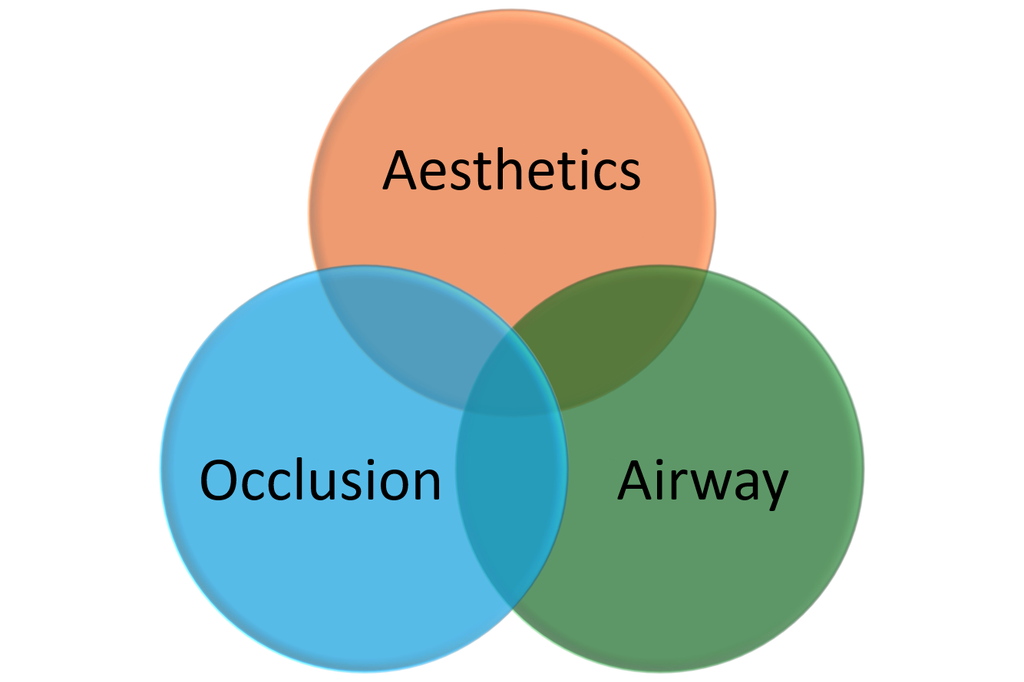
Many patients assume that orthognathic surgery, also known as jaw surgery, is primarily about correcting the bite (occlusion). Historically, that was largely true. For decades, surgical planning focused on achieving an ideal dental occlusion, with facial appearance and airway considerations viewed as secondary outcomes. Modern orthognathic surgery takes a broader view. Today, successful treatment requires balancing three related objectives:
- Occlusion
- Facial aesthetics
- Airway function
The challenge is that these goals do not always point towards exactly the same surgical solution. The best treatment plan is therefore not necessarily the one that creates the “perfect” bite on paper, but rather the one that produces the most favourable overall result for the individual patient, and this is where surgery becomes an art as well as a science.
The Historical Focus: Occlusion First
The historical foundation of orthognathic surgery lies in orthodontics. Treatment planning often began with dental models, measurements and cephalometric analyses. The principal objective was to position the jaws so that the teeth met in an ideal relationship. This remains important – a stable and functional occlusion contributes to efficient chewing, long-term dental health, orthodontic stability and overall treatment success. Patients with severe underbites, overbites, open bites and facial asymmetries often gain substantial functional improvements through correction of skeletal jaw discrepancies.
However, experience shows that a technically perfect occlusion does not automatically create the most attractive face. Patients rarely seek treatment because of measurements on a cephalometric tracing. They seek treatment because of concerns about appearance, function, health, or a combination of all three.
The Rise of Facial Aesthetics-Driven Planning
The jaws form the framework of the face. Changes in jaw position alter the projection of the lips, chin, cheeks, jawline and neck. As a consequence, facial appearance is often one of the most important determinants of postoperative satisfaction.
During his career, Dr Tom Pepper has increasingly sought to balance excellent facial aesthetics with the other goals of surgery. Rather than beginning with the teeth and working outward, he evaluates facial proportions and skeletal balance before considering how the bite can be optimised within those aesthetic goals.
Questions commonly include:
- Is the upper jaw too prominent or deficient?
- Is the lower jaw retruded or protrusive?
- Is the chin adequately projected?
- Is facial height proportionate?
- Is there significant asymmetry?
- How will jaw movements affect the soft tissues?
This philosophy recognises that orthognathic surgery is fundamentally facial surgery rather than simply focussed on the bite.
The Airway Revolution
An important change in orthognathic surgery over the past two decades has been the increasing recognition of airway health. Research has demonstrated strong associations between maxillofacial structure and obstructive sleep apnoea. Patients with retrusive jaws, reduced facial projection and certain skeletal growth patterns often have smaller upper airways and increased susceptibility to airway obstruction during sleep, particularly as they grow older.
The position of the maxilla and mandible directly influences:
- Tongue position
- Soft palate position
- Pharyngeal airway dimensions
- Airway resistance
This does not mean every patient requires airway-focused surgery. However, planning orthognathic movements to optimise the airway, even in patients who do not have a diagnosis of obstructive sleep apnoea (OSA), has become an important consideration. In patients with a formal diagnosis of OSA, optimising the airway becomes the primary goal, and surgery then becomes maxillomandibular advancement (MMA) surgery.
MMA is regarded as one of the most effective surgical treatments for obstructive sleep apnoea and can also produce favourable facial changes in appropriately selected patients. Importantly, the occlusion is unlikely to change significantly in MMA surgery unless orthodontic planning has been incorporated into the surgical pathway. Incorporating this achieves the best overall results, but prolongs treatment.
Maxillary Expansion
A fourth consideration is transverse jaw width. Many patients have a maxilla that is not only retrusive or vertically abnormal, but also too narrow. A narrow upper jaw can contribute to:
- Dental crowding
- Crossbite
- Unfavourable smile aesthetics
In appropriate patients, maxillary expansion may:
- Create space for proper dental alignment
- Improve arch coordination
- Enhance tongue accommodation
- Improve smile width and dental display
The growing interest in surgically assisted expansion techniques and procedures such as SARPE and segmented Le Fort I osteotomy reflects this broader understanding of facial and airway anatomy.
Dr Tom Pepper’s Philosophy
Dr Tom Pepper undertakes planning that involves a detailed assessment of:
|
Occlusion |
Facial Aesthetics |
Airway |
|
|
|
Three-dimensional imaging and virtual surgical planning allow these factors to be evaluated simultaneously. The result is a more comprehensive and personalised treatment plan than was possible in previous decades. Jaw surgery is no longer simply about moving teeth into ideal positions. It is about optimising the relationship between the jaws, face, airway and dentition to achieve the best overall outcome for the patient.
When the Objectives Conflict
Not all patients present straightforward planning decisions. Should treatment prioritise facial aethetics, optimise the bite, or focus on enhancing airway volume? The answer often lies in finding the most appropriate balance rather than pursuing any single objective to the extreme.
The best treatment plan is rarely the one that produces the most idealised cephalometric measurements. It is the one that produces the best combination of function, appearance, stability and long-term health for that individual patient.
Related Articles
- The Complete Guide to Orthognathic Surgery
- Jaw Surgery Recovery Timeline
- Underbite Surgery Explained
- Overbite Surgery Explained
- Maxillomandibular Advancement for Obstructive Sleep Apnoea
- SARPE and Maxillary Expansion Explained

