




Restoring Bone Using Advanced Techniques
Bone grafting is a surgical procedure used to rebuild areas of jawbone that have become too thin or too shallow to support dental implants safely.
Following tooth loss, the jawbone naturally shrinks over time. In some patients, this process is relatively minor. In others, significant bone loss can develop, making dental implant placement more challenging.
Dr Tom Pepper is a Consultant Oral & Maxillofacial Surgeon in London providing bone grafting procedures as part of comprehensive dental implant treatment planning. Bone grafting may allow patients who have previously been told they do not have enough bone for implants to become suitable candidates for treatment.
Private consultations are available in London, including Harley Street and Cromwell Hospital.
What Is Bone Grafting?
Bone grafting is a procedure designed to increase the volume of bone available within the jaw. The aim is to create a stable foundation capable of supporting dental implants and maintaining healthy surrounding tissues. Bone grafting may be performed:
- Before dental implant placement
- At the time of implant placement
- To reconstruct bone defects following tooth loss
- To repair areas affected by previous infection
- To rebuild bone lost following trauma
- As part of treatment following implant failure
The exact approach depends on the location and severity of bone loss.
Why Does Bone Loss Occur?
The jawbone exists primarily to support teeth. When a tooth is removed, the surrounding bone is no longer subjected to normal chewing forces and begins to shrink naturally.
Bone loss may occur as a result of:
- Tooth extraction
- Gum disease
- Dental infection
- Trauma
- Long-term denture wear
- Congenitally missing teeth
- Previous implant failure
The longer a tooth has been missing, the greater the degree of bone loss may become.
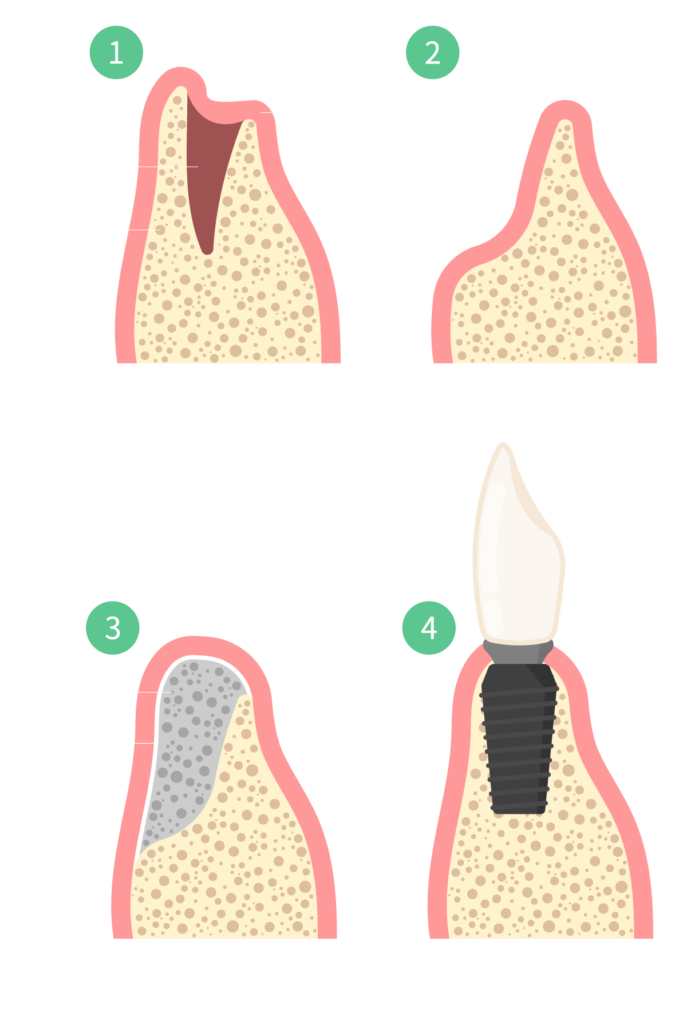
Do I Need Bone Grafting?
Not all patients require bone grafting before dental implant treatment. Many patients have sufficient bone available for straightforward implant placement. A clinical examination and CT scan are usually required to determine whether bone grafting would be beneficial.
Types of Bone Graft
Socket Preservation Grafting
Following tooth extraction, a bone graft may be placed immediately into the extraction socket. This can help reduce the natural collapse of the ridge that occurs after tooth removal and may simplify future implant treatment. Socket preservation is particularly useful when implant placement is planned in a visible area of the mouth where preservation of the natural contour is important.
Guided Bone Regeneration (GBR)
Guided bone regeneration is one of the most commonly performed grafting procedures in implant dentistry. Bone graft material is placed into the deficient area and protected by a specialised membrane. This allows new bone to develop within the treated region while excluding unwanted soft tissue growth.
Ridge Augmentation
Some patients develop significant narrowing of the jawbone following tooth loss. Ridge augmentation procedures are designed to rebuild the width and shape of the jaw to allow placement of appropriately sized implants. This may be particularly important in highly visible areas where both function and appearance are important.
Block Bone Grafting
In more advanced cases, larger grafts may be required. A block of bone may be obtained and secured to the recipient site to restore jaw dimensions. Block grafting can be useful where significant vertical or horizontal bone loss has occurred. This technique is frequently used in more complex reconstructive implant cases.
Sources of Bone Graft Material
Several different graft materials may be used depending on the clinical situation. These include:
- The patient’s own bone (autogenous bone)
- Donor bone (allograft)
- Processed animal-derived grafts (xenografts)
- Synthetic bone substitutes
Each option has advantages and limitations. The most appropriate material depends on:
- The size of the defect
- Implant requirements
- Healing objectives
- Individual patient factors
These options will be discussed during consultation.
Platelet-Rich Fibrin (PRF)
Platelet-Rich Fibrin (PRF) may be incorporated into bone grafting procedures where appropriate. PRF is produced from a small sample of the patient’s own blood and contains concentrated growth factors that support the healing process. Potential benefits include:
- Improved soft tissue healing
- Enhanced wound maturation
- Support for bone regeneration
- Reduced postoperative discomfort
PRF may be used alongside bone grafting, dental implant placement and other reconstructive procedures.
How Successful Is Bone Grafting?
Bone grafting is a well-established technique used throughout implant dentistry and reconstructive maxillofacial surgery. Success depends on several factors including:
- The size of the defect
- Blood supply to the area
- Smoking status
- Oral hygiene
- Medical history
- Surgical technique
In appropriately selected patients, bone grafting can successfully create adequate bone volume for future implant placement.
Risks and Considerations
Potential risks include:
- Partial graft resorption
- Infection (uncommon)
- Need for further grafting in some cases
These risks are reduced through:
- Careful case selection
- Use of appropriate biomaterials
- Controlled surgical technique
Alternatives to Bone Grafting
Bone grafting is only one approach to managing bone loss. Depending on the anatomy and treatment objectives, alternative options may include:
- Short or angled dental implants
- Zygomatic implants
- Custom subperiosteal implants
Not every patient requires grafting, and treatment recommendations are tailored to each individual.
Sedation for Bone Grafting
While many bone grafting procedures can be performed under local anaesthetic, for more extensive treatment or anxious patients, intravenous (IV) sedation and general anaesthesia can be helpful. The most appropriate option will be discussed during consultation.
Why Choose a Consultant Oral & Maxillofacial Surgeon?
Bone grafting requires a detailed understanding of jaw anatomy, bone biology, implant surgery, maxillofacial reconstruction, and tissue healing. As a Consultant Oral & Maxillofacial Surgeon, Dr Tom Pepper combines medical, dental and surgical training to assess and manage both routine and complex reconstructive implant cases.
Frequently Asked Questions
Is Bone Grafting Painful?
Most patients experience only mild to moderate discomfort following bone grafting. Pain is generally well controlled with routine pain relief and typically improves steadily during the first few days after surgery.
How Long Does Bone Grafting Take to Heal?
Healing times vary depending on the size and type of graft. In many cases, several months of healing are required before implant placement can proceed safely. A personalised treatment timeline will be discussed during consultation.
Can Implants Be Placed at the Same Time as Bone Grafting?
Sometimes. In selected cases, bone grafting and implant placement can be performed during the same procedure. In other situations, allowing the graft to heal first provides a more predictable outcome.
What Happens If I Do Not Have Bone Grafting?
Where bone volume is insufficient, conventional dental implant placement may be difficult or impossible. However, alternatives such as zygomatic implants or custom subperiosteal implants may be available in some cases.
Does Smoking Affect Bone Grafting?
Yes. Smoking is associated with impaired healing and higher rates of complications following grafting and implant surgery. Patients are strongly encouraged to stop smoking before treatment whenever possible.
Book a Consultation
If you have been told that you do not have enough bone for dental implants, or are considering implant treatment following tooth loss, arrange a consultation with Dr Tom Pepper.
A comprehensive assessment can determine whether bone grafting, dental implants, zygomatic implants, subperiosteal implants, or alternative reconstructive techniques offer the most appropriate route to long-term restoration of function and appearance.

