




Regeneration, Guided by Your Own Biology
Platelet-Rich Plasma (PRP) treatment uses growth factors derived from your own blood to support tissue repair, skin rejuvenation, and hair restoration. Popularly known as the vampire facial or Dracula facial when combined with microneedling, PRP works by stimulating the body’s natural healing and regenerative processes.
Dr Tom Pepper is a Consultant Oral and Maxillofacial Surgeon in London with specialist expertise in facial anatomy, facial ageing, regenerative medicine, and tissue healing. Every PRP treatment is carefully tailored to the individual, with the aim of supporting natural regeneration while maintaining a subtle and natural appearance.
Consultations are available at Harley Street in central London and Cromwell Hospital in Kensington.
What Is PRP?
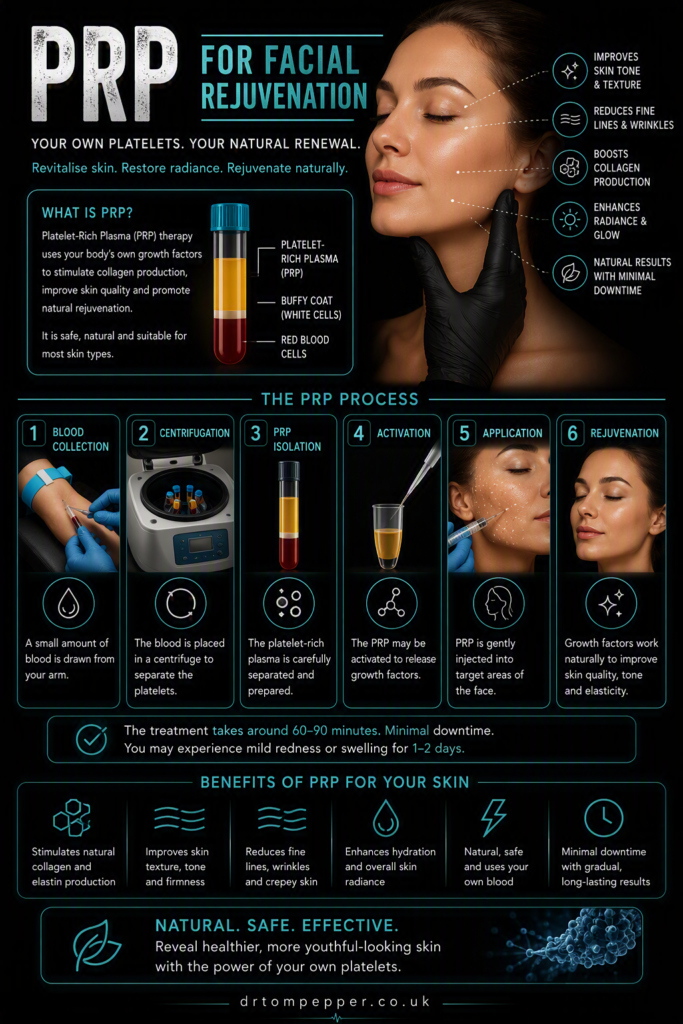
Platelet-Rich Plasma (PRP) is derived entirely from your own blood.
A small blood sample is taken and processed using a specialised centrifuge to separate and concentrate the platelets. These platelets contain growth factors and signalling molecules that play a key role in tissue repair and regeneration.
When reintroduced into the treatment area, PRP helps support:
- Collagen production
- Tissue repair
- Skin regeneration
- Improved circulation
- Hair follicle stimulation
- Wound healing
Because PRP uses your own biological material, it is often referred to as an autologous regenerative treatment.
A Natural Regenerative Approach
Unlike dermal fillers, PRP does not add volume or alter facial contours. Unlike anti-wrinkle treatments, PRP does not affect muscle activity. Instead, PRP works by supporting the body’s own repair mechanisms, encouraging gradual improvement in tissue quality over time.
The result is often:
- Healthier skin
- Improved texture
- Better elasticity
- Enhanced skin quality
- Natural rejuvenation
This makes PRP particularly attractive to patients seeking subtle improvement without looking treated.
Why Choose a Consultant Facial Surgeon for PRP?
Successful regenerative treatment requires more than simply administering injections. Different tissues respond differently to regenerative therapies, and careful assessment is required to determine:
- Appropriate treatment areas
- Treatment depth
- Product preparation
- Combination therapies
- Suitability for treatment
As a Consultant Oral and Maxillofacial Surgeon, Dr Tom Pepper combines expertise in:
- Facial anatomy
- Tissue healing
- Regenerative medicine
- Facial surgery
- Wound healing biology
This allows PRP treatment to be integrated into a broader understanding of facial ageing, skin quality, and tissue regeneration.
What Can PRP Treat?
Facial Rejuvenation
PRP is frequently used to improve overall skin quality and support natural rejuvenation. Benefits may include:
- Improved skin texture
- Better hydration
- Enhanced skin quality
- Increased skin radiance
- Reduction in fine lines
The focus is on improving the condition of the skin itself rather than changing facial features.
Under-Eye Rejuvenation
The delicate skin beneath the eyes is often one of the earliest areas to show signs of ageing. PRP may help improve:
- Thin skin
- Fine lines
- Skin quality
- Dark or tired appearance in selected patients
Treatment is carefully planned due to the complex anatomy of the lower eyelid region.
Hair Loss Treatment
PRP is commonly used as part of treatment for certain types of hair loss. By delivering concentrated growth factors to the scalp, treatment may help support:
- Hair density
- Hair quality
- Hair thickness
- Follicular activity
PRP is often incorporated into wider hair restoration programmes.
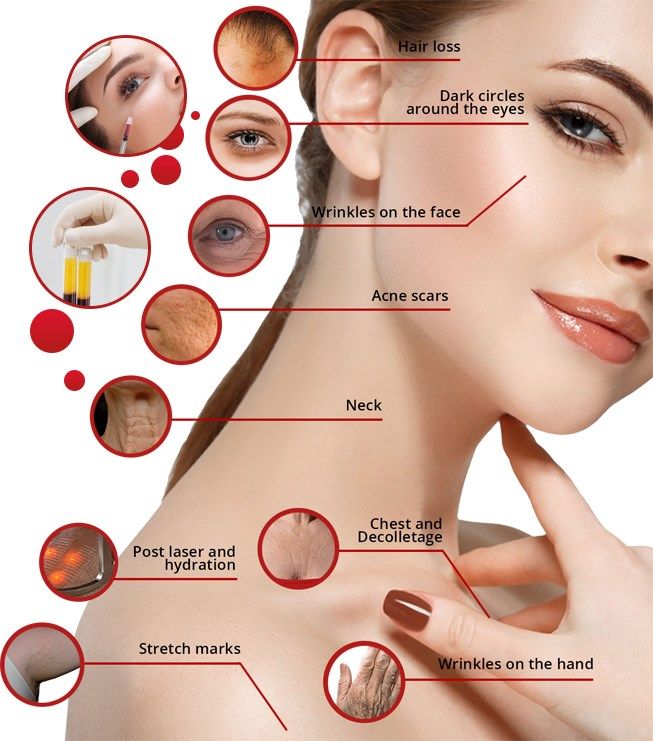
Acne Scarring
PRP may be used alongside treatments such as microneedling to support tissue repair and improve skin quality in selected patients with acne scarring.
Post-Procedural Recovery
PRP may also be used to support healing and recovery following selected surgical or aesthetic procedures such as facial fat grafting.
The Experience
Treatment begins with a simple blood draw, followed by careful preparation of the PRP by centrifugation. The platelet-rich plasma is then precisely reintroduced into targeted areas using refined techniques. Treatment typically takes 45–60 minutes. Downtime is minimal, with mild redness or sensitivity resolving over the following days.
PRP vs Polynucleotides
Both treatments aim to stimulate regeneration, but they work differently.
PRP
Uses your own blood-derived growth factors to support:
- Tissue repair
- Collagen production
- Healing
- Regeneration
Polynucleotides
Use highly purified DNA fragments to support:
- Cellular repair
- Collagen stimulation
- Hydration
- Tissue regeneration
Both treatments are valuable regenerative tools and may be used individually or in combination depending on treatment goals.
PRP vs Skin Boosters
Although both treatments aim to improve skin quality, they achieve this through different mechanisms.
PRP stimulates regeneration using your body’s own biological growth factors, where as skin boosters use hyaluronic acid to improve hydration, skin elasticity, and skin texture.
Patients concerned primarily with skin quality often benefit from combining regenerative and hydration-focused treatments.
PRP vs Dermal Fillers
PRP and dermal fillers address different concerns.
PRP
Improves:
- Skin quality
- Regeneration
- Tissue health
Dermal Fillers
Improve:
- Volume loss
- Facial contour
- Structural support
- Facial proportions
A detailed assessment helps determine which approach is most appropriate.
PRP vs Microneedling
PRP and microneedling are both regenerative treatments, but they differ in how they stimulate renewal.
Microneedling works by creating controlled micro-injury within the skin, triggering collagen production and improving texture over time through the body’s natural repair response.
PRP, by contrast, introduces a concentrated source of your own growth factors directly into the skin—enhancing cellular repair and accelerating regeneration at a biological level.
In practice, the two are often combined – in the so-called vampire facial or Dracula facial – which allows microneedling to create pathways within the skin while PRP delivers a targeted regenerative signal to amplify the healing response – resulting in more refined, comprehensive improvement.
Results
PRP works gradually through natural biological processes. Improvements develop gradually as the skin responds to the regenerative stimulus.
Over time, skin appears smoother, more even in tone, and visibly revitalised—without abrupt or artificial change.
A series of treatments is often recommended to achieve optimal, cumulative results.
Improvements may include:
- Better skin quality
- Improved texture
- Increased radiance
- Enhanced tissue quality
- Improved hair density in suitable candidates
Most patients notice progressive improvement over a period of weeks and months.
Frequently Asked Questions
What does PRP stand for?
PRP stands for Platelet-Rich Plasma, a regenerative treatment created using concentrated platelets obtained from your own blood.
Is PRP natural?
Yes. PRP uses your own blood-derived growth factors and does not involve synthetic fillers or foreign biological products.
How many PRP treatments are needed?
This depends on the treatment area and individual goals. A course of treatments is often recommended to optimise results.
How long does PRP take to work?
Results develop gradually as regenerative processes occur within the tissues. Most patients notice progressive improvement over several weeks.
Can PRP be combined with other treatments?
Yes. PRP is frequently combined with microneedling, polynucleotides, skin boosters, hair restoration treatments, and surgical facial rejuvenation procedures where appropriate.
Is a vampire facial the same as PRP?
A vampire facial is one form of PRP treatment. While PRP may be injected directly into the skin, the term vampire facial usually refers specifically to PRP used in combination with microneedling.
Is PRP suitable for hair loss?
PRP may be beneficial for selected patients experiencing hair thinning or pattern hair loss. Suitability is assessed during consultation.
Why Choose Dr Tom Pepper?
Regenerative medicine sits at the intersection of biology, anatomy, and tissue healing.
As a dual-qualified Consultant Oral and Maxillofacial Surgeon trained in both medicine and dentistry, Dr Tom Pepper brings extensive expertise in:
- Facial anatomy
- Tissue regeneration
- Wound healing
- Facial surgery
- Regenerative medicine
This allows PRP treatment to be delivered within a medically-led, evidence-based framework that prioritises safety, natural results, and long-term tissue health.
Consultation
Consultations for PRP treatment are available in London at Harley Street and Cromwell Hospital. A detailed assessment allows discussion of your concerns, regenerative treatment options, and whether PRP may form part of an appropriate treatment strategy.
Book Your Appointment
For PRP treatments in London, delivered with surgical-level precision and a deep understanding of tissue regeneration, book a consultation to begin your personalised plan.

