




Why the Chin Matters
The chin is one of the most important structures in facial aesthetics. Although it occupies a relatively small area of the face, its position has a profound influence on profile balance, jawline definition, neck contour, and the perceived size of the nose.
A well-positioned chin creates harmony between the forehead, nose, lips and neck. A weak chin, by contrast, can make the nose appear larger, reduce jawline definition and contribute to an unbalanced facial profile.
For this reason, chin enhancement is one of the most powerful procedures in facial surgery. Even relatively small changes in chin position can produce significant improvements in overall facial appearance.
What Makes a Perfect Chin?
Patients frequently ask about an “ideal” or “perfect” chin. The reality is that no single measurement defines the perfect chin. Instead, an attractive chin is one that is proportionate to the rest of the face. A well-balanced chin should:
- Complement the nose
- Support the lips
- Strengthen the jawline
- Improve lower facial proportions
- Create a harmonious profile
- Maintain natural facial identity
The goal is to create the best relationship between all facial structures. Modern facial aesthetic analysis therefore focuses on balance rather than isolated measurements.

The Chin and Facial Balance
The chin forms the anterior boundary of the lower face and plays a crucial role in determining facial proportions. When adequately projected, the chin can:
- Improve profile harmony
- Create a stronger jawline
- Improve neck definition
- Make the nose appear less prominent
- Create a more youthful and balanced appearance
This explains why procedures such as sliding genioplasty, chin implants and orthognathic surgery can have such powerful aesthetic effects. Importantly, improving chin position often changes how the entire face is perceived.
Rickett’s E-Line
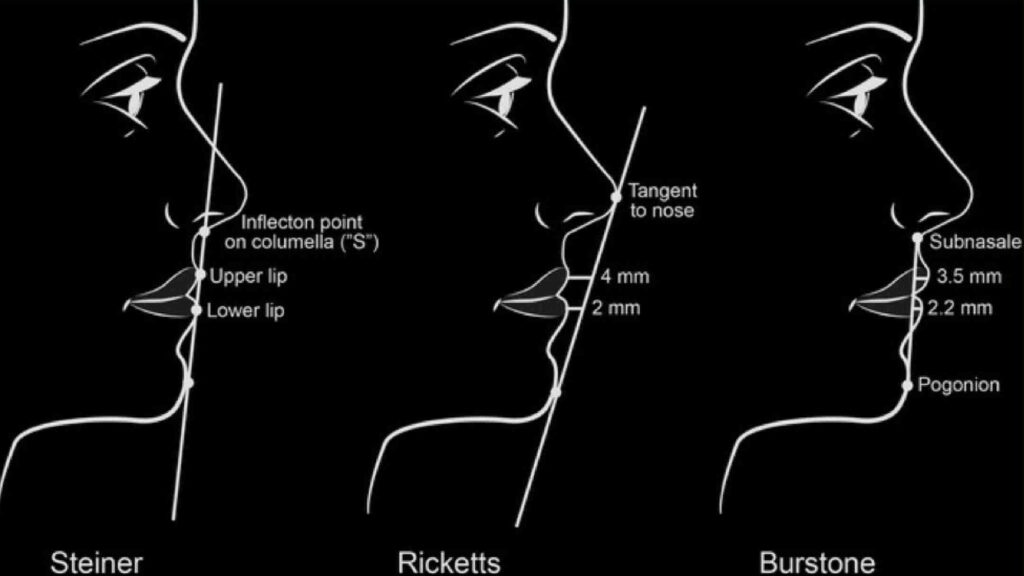
One of the most influential concepts in facial aesthetics is the esthetic line, commonly known as the E-line, introduced by Ricketts. The E-line is drawn between:
- The tip of the nose
- The most prominent point of the soft-tissue chin
The position of the lips is then assessed relative to this line. In traditionally attractive profiles:
- The upper lip lies 4 mm behind the line.
- The lower lip lies 2 mm behind the line.
Because the chin anchors the posterior end of the E-line, chin position has a major influence on facial balance. A weak chin often makes the lips appear excessively prominent even when lip volume is completely normal. Advancing the chin may therefore improve profile aesthetics without touching the lips themselves.
Stoner and the Whole Face Approach
Stoner studied aesthetically acceptable facial profiles and emphasised the importance of evaluating the profile as a whole. This remains one of the fundamental principles of modern facial surgery.
An attractive face is not created by optimising one measurement in isolation. It arises from balanced relationships between multiple structures.
Peck and Peck: Beauty Beyond Measurements
Peck and Peck advanced facial aesthetic analysis by studying photographs of attractive individuals rather than relying solely on skeletal measurements. Using a vertical reference plane extending between the soft-tissue nasion and pogonion, they developed methods for evaluating the sagittal positions of the lips and chin.
Their work helped shift facial analysis from: “What measurement is normal?” to “What actually looks attractive?”. This philosophy strongly influences contemporary genioplasty and facial aesthetic surgery.
Holdaway and Soft-Tissue Harmony
Holdaway recognised that facial appearance cannot be understood by analysing the skeleton alone. His analysis incorporated soft-tissue relationships using the subnasale, soft-tissue chin and Frankfort horizontal plane. The importance of this work remains highly relevant today.
Two patients can have similar skeletal anatomy but very different appearances because of differences in:
- Lip thickness
- Skin thickness
- Soft-tissue chin thickness
- Facial fat distribution
This is one reason why successful facial surgery requires assessment of both skeletal and soft-tissue anatomy.
Merrifield’s Z-Angle
Merrifield introduced the Z-angle, another important profile analysis. The angle is created between:
- The Frankfort horizontal plane
- A line connecting the most prominent lip and the soft-tissue chin
The Z-angle provides insight into the balance between the lips and chin. Patients with retrusive chins frequently demonstrate reduced Z-angles, while chin advancement often moves these measurements towards values associated with attractive profiles.
Although newer methods are now available, the underlying concept remains unchanged: the lips and chin should work together as a balanced aesthetic unit.
Burstone and Profile Balance
Burstone further refined profile analysis through measurements based on a line extending between the subnasale and the soft-tissue pogonion. His work highlighted that the position of the lips can only be interpreted meaningfully when considered relative to chin projection.
This explains why some patients seeking lip enhancement may actually benefit more from chin augmentation, while others requesting chin surgery may have underlying dental or jaw discrepancies that should be addressed first.
González-Ulloa and the Profile Plane
González-Ulloa and Stevens introduced a vertical reference plane extending through the soft-tissue nasion and perpendicular to the Frankfort horizontal plane. Their observations suggested that attractive profiles frequently demonstrated a chin that was positioned close to this vertical reference. Although modern facial analysis has become more sophisticated, this concept reinforced the importance of adequate chin projection in achieving facial harmony.
The True Vertical Line
Popularised by Arnett and colleagues, the True Vertical Line (TVL) is designed to assess facial projection using landmarks that are visible during everyday clinical examination. Unlike many traditional cephalometric analyses, it evaluates how the face actually appears when viewed naturally.
The True Vertical Line is typically drawn through the soft-tissue subnasale, the point where the base of the nose meets the upper lip, while the head is held in a natural and relaxed position. Once established, multiple facial structures can be assessed relative to this line, including:
- Upper lip projection
- Lower lip projection
- Chin projection
- Midface projection
- Overall profile balance
Because it uses real facial landmarks rather than hidden skeletal points, it often corresponds more closely to how patients actually perceive facial attractiveness.
Attractive profiles often demonstrate a close relationship between the soft-tissue chin and the True Vertical Line. In men, the soft-tissue pogonion commonly lies close to the TVL or only slightly behind it. In women, the chin frequently sits slightly further posteriorly, contributing to a softer profile while maintaining facial balance.
When the chin lies significantly behind the TVL, patients often demonstrate:
- A weak chin
- Reduced jawline definition
- Increased facial convexity
- Poorer neck contour
- Greater apparent nasal prominence
Procedures such as genioplasty, chin augmentation or orthognathic surgery may be used to improve these relationships.
One of the greatest strengths of the TVL is that it allows assessment of the entire profile simultaneously. It helps determine whether an apparent chin deficiency is truly caused by:
- A small chin
- A retrusive lower jaw
- Excessively protrusive lips
- Maxillary protrusion
- Midfacial deficiency
- A combination of factors
This is particularly important because not every patient who appears to have a weak chin actually needs chin surgery. Some patients may benefit more from orthognathic surgery, orthodontics or comprehensive facial analysis rather than isolated chin augmentation. The True Vertical Line helps place the chin in the broader context of overall facial harmony.
The Barcelona Line
The Barcelona Line represents a more contemporary approach to facial aesthetic assessment. Rather than focusing on isolated measurements, it evaluates the relationship between multiple facial structures, including the forehead, nose, lips and chin. Like many modern analyses, it acknowledges that facial attractiveness cannot be reduced to a single angle or distance.
Vertical Chin Proportions
While most patients focus on how far the chin projects forwards, the vertical height of the chin is equally important in creating facial harmony. An attractive lower face is not simply defined by a strong chin, but by balanced proportions between the upper, middle and lower thirds of the face.
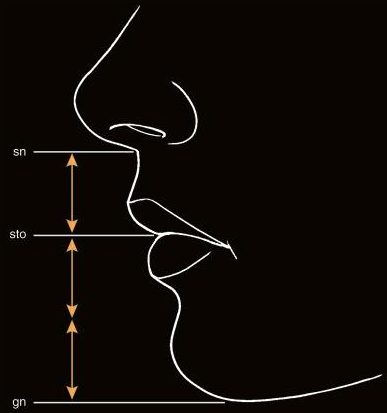
Traditionally, the lower face is divided into two segments: the upper lip and the lower lip-chin complex. In aesthetically balanced faces, the distance from the base of the nose (subnasale) to the upper lip is typically shorter than the distance from the lower lip to the bottom of the chin (menton).
An excessively short chin can make the lower face appear compressed, weak or underdeveloped, whereas an overly long chin may create a disproportionate, aged or masculine appearance. The ideal vertical chin height varies according to sex, ethnicity and overall facial proportions, but the goal is always the same: to create a smooth and harmonious transition between the lips, chin and jawline.
One advantage of a sliding genioplasty over a chin implant or filler is that vertical height can be adjusted as well as projection. The chin can be lengthened, shortened, advanced or repositioned to optimise lower facial proportions. As a result, successful chin surgery is not simply about modifying chin prominence; it is about creating the correct balance in all three dimensions: projection, width and vertical height.
How Wide Should the Chin Be?
There is no single ideal measurement for every individual, but several useful aesthetic guidelines exist. In general, the soft-tissue width of the chin is often considered aesthetically balanced when it approximates the distance between the medial limbi of the eyes or falls within the width of the intercanthal region. Other analyses compare chin width to mouth width, lower facial width and bigonial width (the distance between the angles of the mandible).
A useful practical principle is that the chin should appear slightly narrower than the mouth and blend smoothly into the mandibular body rather than appearing as a separate structure.
Sex Differences in Chin Width
Sex is one of the most important determinants of ideal transverse chin proportions.
Male faces typically demonstrate:
- Greater chin width
- Stronger lateral contour
- Increased bigonial width
- A more square lower face
Female faces generally demonstrate:
- Narrower chins
- More tapered contours
- Softer transitions into the jawline
- A more heart-shaped or oval lower facial appearance
For this reason, chin narrowing is often undertaken as part of Feminising Genioplasty (Chin Feminisation Surgery).
Why There Is No Universal Answer
One of the most important lessons from over a century of facial aesthetic research is that no single chin position is ideal for every individual.
The perfect chin for a facial feminisation patient, for example, may be very different from the ideal chin for a male jawline enhancement procedure.
Modern facial surgery therefore incorporates the art of creating individualised harmony rather than chasing arbitrary measurements.
The Art of Creating the Perfect Chin
The perfect chin is not defined by the E-line, the Z-angle, the True Vertical Line, or any other individual measurement. While these analyses are valuable guides, ultimately creating the perfect chin comes down to the art of surgery. In many cases, the best result is not one in which people notice the chin itself. It is one in which balance has been established between the forehead, the nose, the lips, the jawline, and the neck.
The perfect chin should look natural, proportionate, and appropriate for the individual patient.

